

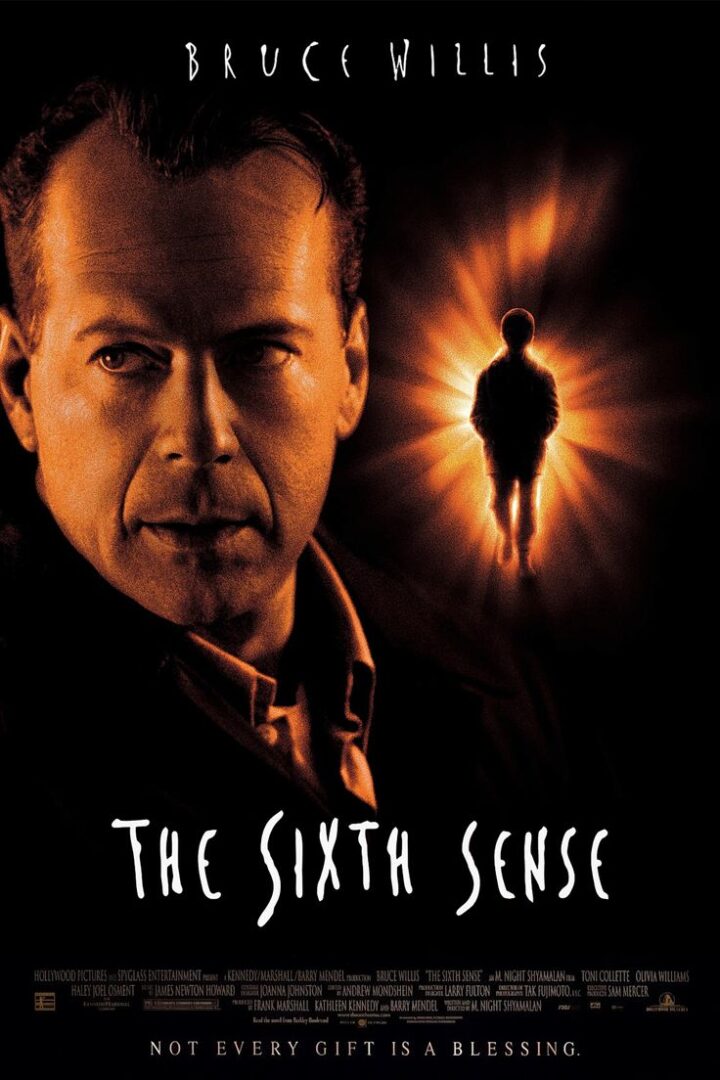
The Sixth Sense
Everyone is haunted. Not by ghosts but by what they cannot let themselves feel
EST V ACT domestic box office revenue
$230 – 256MM v $294MM
Mythosis universal quests used
3
Audience appeal
16.26 – 18.07%
Script Score
0.57
The Sixth Sense is one of the clearest modern expressions of the grief-as-haunting theme. Most stories talk about “inner demons.” Shyamalan goes deeper, he shows how grief itself becomes a haunting that lives in the body. It’s a story where every character is pursued not by spirits, but by the somatic residue of unresolved trauma.
The film’s famous twist works not because it is clever but because the story has been whispering its truth from the beginning: Everyone here is grieving, And their bodies know it long before their minds do.
1. 97% of the plot of The Sixth Sense borrows events from 3 mythological tales
1A. Parallels between Cole & Odysseus
The desire to be in a safe environment drives Cole’s quest for Tranquillity. The quest borrows events from the tale of Odysseus in Greek mythology. Both Cole and Odysseus are driven by a single, elemental aim: to return to a place of safety. For Odysseus that aim is homecoming to Ithaca; For Cole it is a secure inner and outer life free from terror of ghosts. Each journey is a perilous passage through hostile realms, the intervention of an expert guide, trials that demand acceptance and finally a restoration of peace.
1B. Parallels between Malcolm & Oedipus
The desire to protect loved ones drives Malcolm’s quest for Family. The quest borrows events from the tale of Oedipus in Greek mythology. Both Malcolm and Oedipus are propelled by a single, urgent motive: to protect the people they love and to restore a sense of family. Their quests begin with conviction and purpose, move through a period of self-deception and end in a painful recognition that demands a personal sacrifice. Read side by side, their stories trace how protective love can harden into hubris, how denial can be a form of care and how truth often requires sacrifice.
1C. Parallels between Lynn & Demeter
Every human desire has two universal quests, fulfilled and unfulfilled. In the Sixth Sense, Malcolm mirrors the unfulfilled quest of Family where Lynn borrows from the fulfilled one.
The desire to protect loved ones drives Lynn’s quest for Family. The quest borrows events from the tale of Demeter in Greek mythology. The journeys of both Lynn & Demeter begin from a place of rupture. Demeter experiences the literal abduction of Persephone and the cosmic grief that follows. Lynn experiences a modern estrangement – her son is withdrawn, frightened, and unreachable. In both cases the mother’s identity is reframed by loss, caregiving becomes a mission and ordinary life is suspended.
1D. Parallels between Anna & Psyche
Anna has an under- developed quest of Social Contact. The desire for companionship borrows events from the tale of Psyche in Greek mythology. Their quests are about relearning human contact. Both women are struck by misfortune, and love teaches them to live again.
For a deeper exploration of how to create a unique narrative structure from a theme see our essay on Grief as Haunting
Mythosis plot structure
# 8,351
Tales interweaved
Oedipus, Odysseus & Demeter
I. How does interweaving mythological tales lead to infinite story plots?
II. Can the pursuit of a Desire have more than one quest?
2. Potential of The Sixth Sense’s plot structure: $230 – 256MM
The interweaving of 32 mythological tales generates over a billion unique stories. By using these 32 tales, we can extract the plot structure of any story across various genres. Our study of blockbuster, hit and flop plot structures led to the discovery of a set of principles for creating compelling stories. Let’s examine how well the plot structure of The Sixth Sense adheres to the storytelling principles.
2A. Plot structure evaluation of A Quiet Place
- All Blockbusters have at least 3 universal quests. The Sixth Sense uses both the universal quests of Family and the quest of Tranquillity.
- In Blockbusters, each universal quest is mirrored by ONLY ONE character. Cole mirrors the universal quest of Tranquillity. Malcolm mirrors the unfulfilled quest of Family whereas Lynn mirrors the fulfilled quest.
- Every Blockbuster character borrows at least 35% of the universal quest. Malcolm borrows 52% events from the quest of Family. Cole borrows 36% from Tranquillity. Lynn borrows 18%.
- Blockbusters have a quest interweaving threshold of 0.5. Interweaving occurs when events of 2 quests occur simultaneously in the story. The Sixth Sense’s quest interweaving score of 0.67 is above par.
2B. Box office revenue estimation of The Sixth Sense
The Sixth Sense’s narrative structure is built as a layered framework of three universal quests. Its emotional depth comes from the strong use of the Family and Tranquillity quests. While the high interweaving score explains the film’s thematic resonance. This mythic scaffolding is further elevated by the high-concept premise of a child who can see ghosts.
The Script Score measures a plot structure’s adherence to the four principles of Mythosis Code. We use the Script Score to estimate a movie’s audience appeal & revenues. Blockbuster plot structures have a score of at least 0.64 and appeal to 20% of the audiences.
Script Score
0.57
Audience appeal
16.26% – 18.07%
I. How is Mythosis Code used to estimate revenues?
II. Aren’t box-office revenues influenced by several factors beyond just the story plot?
Contact us for Mythosis plot structure # 8,351
Tags: Demeter, Family, Odysseus, Tranquillity, Oedipus, M. Night Shyamalan, Buena Vista Pictures Distribution, 1999