

K Pop Demon Hunters
Reach without Resonance
EST v ACT domestic box office revenue
$57 – 78MM/NA
Mythosis universal quests used
4
Audience appeal
1.50% – 1.82%
Hidden potential
NA
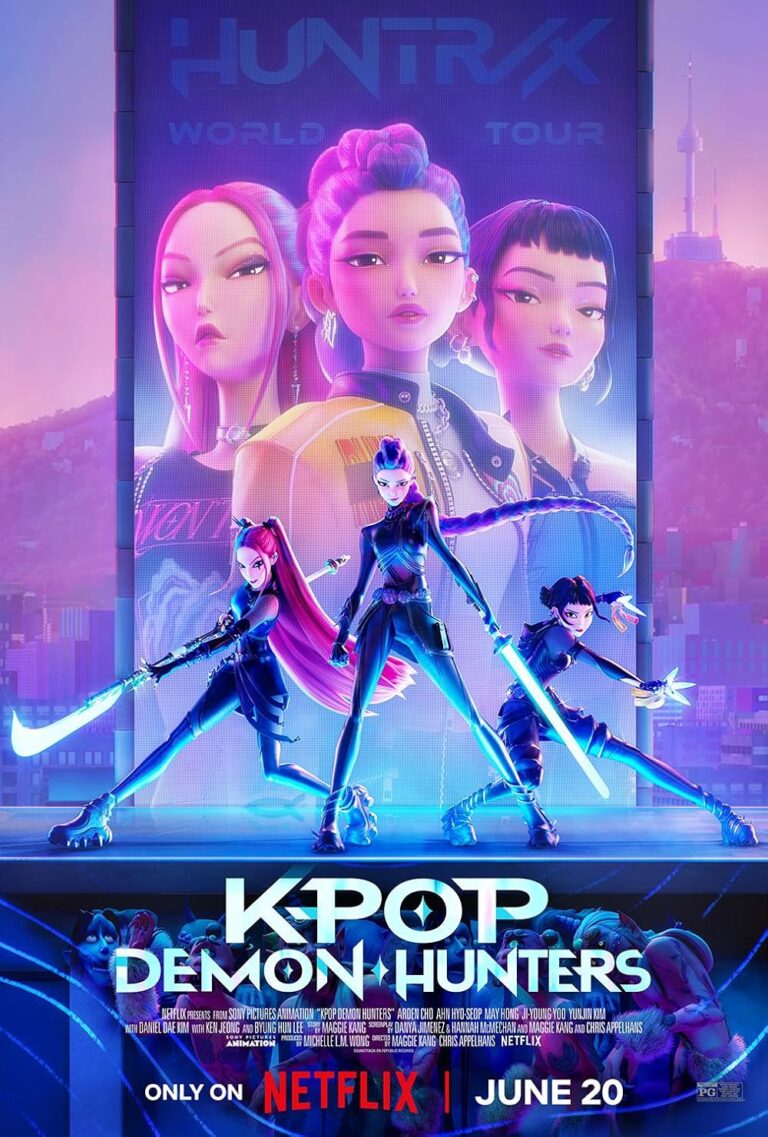
K‑Pop Demon Hunters, Netflix’s neon‑lit fusion of idol culture and supernatural myth, reframes the timeless romance of Psyche and Eros against the spectacle of fandom and demonic conflict. At its core is a collision of agendas: a girl group balancing the glamour of celebrity with the peril of moonlighting as demon hunters, a villainous force demanding the souls of fans and a boy torn between duty and idealism.
The film’s music, choreography and dazzling stagecraft are undeniably hypnotic. Yet beneath the sensory blitz lies a fragile narrative architecture—quests unevenly distributed, mythic fidelity under-developed and an ending compromised by abrupt resolution. The result is a story ambitious in theme but one that struggles to fully deliver on its mythic promise.
1. The invisible plot structure of K Pop Demon Hunters
The script of K Pop Demon Hunters borrows 96% of its events from 4 Universal quests
The desire to punish offenders drives Gwi-Ma’s quest of Vengeance. The quest borrows events from the tale of Duryodhan in Hindu mythology. Duryodhan’s treacherous attempt to take over the kingdom is similar to Gwi-Ma repeatedly trying to take over Earth.
Two desires drive Rumi’s quest
- The desire to ensure order drives Rumi’s quest. The quest borrows events from the tale of Bhishm in Hindu mythology. Both Bhishm & Rumi vow to protect their kingdom from falling into chaos.
- The desire for companionship drives Rumi’s quest for Social contact. The quest borrows events from the tale of Psyche in Greek mythology. Both Psyche and Rumi mistrust the “monster” that saved them but later fall in love.
The desire for fairness and justice drives Jinoo’s quest of Idealism. The quest borrows events from the tale of Prometheus in Greek mythology. Similar to Prometheus, Jinoo rebels to stop the exploitation by unscrupulous forces.
Zoey & Mira have non-existent quests; they share a part of Rumi’s first quest.
Mythosis Plot Structure:
#30586
Tales Interwoven:
Duryodhan, Psyche, Prometheus
2. The potential of K Pop Demon Hunters’ plot structure: $57 – 78 MM
The interweaving of 32 mythological tales generates over a billion unique stories. By using these 32 tales, we can extract the plot structure of any story across various genres. Our study of blockbuster, hit and flop plot structures led to the discovery of a set of principles for creating compelling stories. Let’s examine how well the plot structure of Send Help adheres to the storytelling principles.
2A. K Pop Demon Hunters’ adherence to MYTHOSIS CODE
- All Blockbusters have at least 3 universal quests. K Pop Demon Hunters uses the universal quests of Companionship, Order, Power & Idealism.
- In Blockbusters, each universal quest is mirrored by ONLY ONE character for consistency. Jinoo mirrors the universal quest of Idealism whereas Gwi-Ma mirrors Power. However, Rumi mirrors the quests of Order & Companionship.
- Every Blockbuster character borrows at least 35% of the universal quest for complexity. Jinoo borrows 27% events from the quest of Idealism. Rumi borrows 26% from the quest of Companionship and 8% from the quest of Order. Gwi-Ma borrows 7% events from Power.
- Blockbusters have a quest interweaving threshold of 0.5. Interweaving occurs when events of 2 quests occur simultaneously in the story. K Pop Demon Hunters’ quest interweaving score of 0.67 is above par.
2B. Plot structure evaluation of K Pop Demon Hunters
- Quest Diversity Is Strong, but Execution Is Uneven: The script has potential for rich emotional and ideological layering, but risks incoherence without disciplined mapping.
- Flawed Character–Quest Mapping: Rumi’s dual quest role fragments her arc, confuses audience empathy and reduces narrative clarity.
- Quest Depth Is Limited to 2 Characters: All characters fall short of the complexity threshold but the third shallow arc diminishes emotional resonance.
- Quest Interweaving Is Technically Strong: The story structure supports interwoven narrative beats. Unfortunately, the emotional payoff is limited by weak individual arcs.
Strengthening individual arcs and enforcing quest discipline could significantly elevate its impact.
2C. Box office revenue estimation of K Pop Demon Hunters
The Script Score measures a plot structure’s adherence to the four principles of Mythosis Code. We use the Script Score to estimate a movie’s audience appeal & revenues.
Blockbuster plot structures have a score of at least 0.64 and appeal to 20% of the audiences. K Pop Demon Hunters with a script score of 0.05 will appeal to 1.50% – 1.82% of the population.
Script Score
0.05
Audience Appeal
1.50% - 1.82%
3. Ways to Transform K-Pop Demon Hunters into a Blockbuster
K-Pop Demon Hunters demonstrates flashes of originality through its genre fusion, character concept and world-building. Yet its uneven quest development, fragile internal fidelity and underuse of classical myth limit its impact. By strengthening narrative cohesion, deepening the third universal quest the film could transform from a promising experiment into a blockbuster.
Unlocking hidden potential with Mythosis Blueprint #30586
Tags: Psyche, Prometheus, Duryodhan, Social contact, Idealism, Vengeance, Maggie Kang, Chris Appelhans, Danya Jimenez, Hannah McMechan, Netflix, 2025